

The internet is filled with websites that publish information across multiple categories, helping readers discover new ideas, learn about emerging trends, and stay informed about different subjects. ScoopByte.com is a website name that may attract users interested in digital content, online information, and a variety of topics.
Understanding what topics ScoopByte.com covers can help readers determine whether the platform matches their interests. However, a website’s actual content should be verified through its official pages rather than assumed from its domain name alone.
This article explores the potential topic areas readers may investigate, how to evaluate the website’s content, and what to consider before relying on information published online.
Understanding ScoopByte.com
ScoopByte.com has a name that combines the idea of a “scoop,” or an interesting piece of information, with “byte,” a term commonly associated with digital technology. This combination gives the domain a technology-oriented or online media impression.
However, the website’s name alone does not establish its specific editorial focus. To understand its actual coverage, visitors should review its homepage, category pages, recent articles, and About Us section.
A website’s topic range can change over time. Some platforms focus on a particular niche, while others publish general-interest content across several industries.
Main Topics Covered by ScoopByte.com
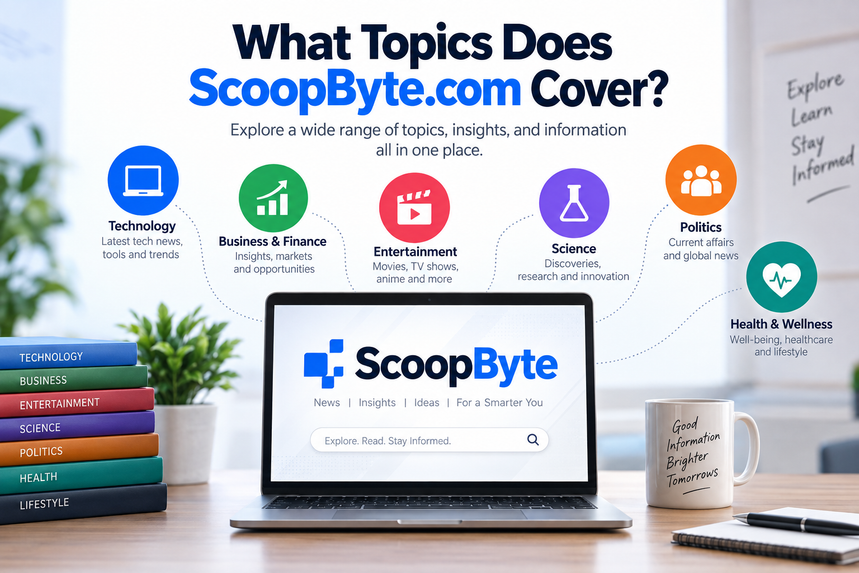
Based on the website’s homepage and editorial policy, ScoopByte has presented content across several broad categories, including technology, business, science, politics, and health. Its homepage also features entertainment-related articles and practical online guides.
Let’s explore these topic areas in more detail.
1. Technology and Digital Trends
Technology is one of the key areas associated with ScoopByte.com. The website’s editorial policy explicitly mentions technology news and analysis.
Technology-related content can help readers understand developments in the digital world, including software, online platforms, emerging tools, and technical concepts.
Potential areas readers may explore include:
- Technology news and developments
- Digital tools and online services
- Software-related topics
- Internet trends
- Technology explanations
The specific subjects and depth of coverage depend on the articles available on the website.
2. Business and Finance
ScoopByte’s editorial policy identifies business as one of its coverage areas. Its homepage has also featured content related to fintech and financial topics.
Business-related content can be useful for readers interested in companies, digital commerce, financial technology, and economic developments.
Topics visitors may encounter include:
- Business news and insights
- Financial technology
- Digital finance
- Business strategies
- Online financial tools
Important: Financial articles should be evaluated carefully, particularly when they discuss investments, trading, or potential earnings. Readers should verify information using reliable sources before making financial decisions.
3. Entertainment and Streaming
Entertainment is another notable subject on ScoopByte.com. The homepage has featured articles about movies, streaming platforms, anime, and television-related content.
This type of content may appeal to users who want to discover entertainment options or learn more about popular media.
Common entertainment-related topics include:
- Movies and television shows
- Streaming platforms
- Anime recommendations
- Web series
- Entertainment guides
Some of the website’s published articles have focused on alternatives to streaming and entertainment platforms.
Readers should distinguish between general entertainment information and links to third-party services, especially when evaluating unfamiliar websites.
4. Science and Informational Content
ScoopByte’s editorial policy lists science among its news and analysis categories.
Science-focused content can introduce readers to research, discoveries, and developments across different fields.
Possible areas of interest include:
- Scientific developments
- Research-related news
- Technology and science connections
- Educational explanations
- New discoveries
When reading scientific articles, users should check whether the content references credible research, qualified experts, or original sources.
The presence of science in the editorial policy does not mean every science topic is regularly published or currently available.
5. Health and Wellness
Health is also identified in ScoopByte’s editorial policy as a subject for news and analysis.
Health-related information can help readers learn about general wellness and developments in healthcare. However, the quality and currency of individual articles should be assessed before relying on them.
Potential areas include:
- General health information
- Wellness topics
- Healthcare developments
- Health-related research
- Lifestyle and well-being
Readers should consult qualified healthcare professionals for personal medical advice rather than relying solely on general online articles.
6. Politics and Current Affairs
ScoopByte’s editorial policy includes politics among its stated coverage areas.
Political and current-affairs content requires particular attention to sources, dates, and context. News can change rapidly, and older articles may no longer reflect current circumstances.
When exploring political content, readers should consider:
- Publication date
- Original sources
- Distinction between reporting and opinion
- Relevant context
- Whether claims are independently supported
Comparing information from multiple reputable sources can help readers develop a more complete understanding of a topic.
7. Online Guides and Practical Information
ScoopByte’s homepage has featured practical guides and list-based articles covering subjects such as streaming alternatives, online tools, and entertainment platforms.
This type of content is designed to answer specific questions or help readers explore different options.
Examples of guide formats include:
| Guide Type | What Readers May Learn |
|---|---|
| Alternative websites | Other platforms offering related services |
| Streaming guides | Information about movies and online viewing |
| Technology explainers | Basic concepts and digital tools |
| Recommendation lists | Different options within a topic |
| Online platform guides | General information about digital services |
The usefulness of each guide depends on how accurately it describes its subject and whether the information is up to date.
How to Find the Topics You Are Interested In
If you want to explore ScoopByte.com, following a simple process can make your experience more efficient.
Step 1: Visit the Homepage
Start by opening the website’s homepage. Look at the available navigation menus, featured content, and article sections.
The homepage can help you understand how the website organizes its information.
Step 2: Review the Latest Articles
Check recent posts to identify the subjects the website has been publishing.
Pay attention to:
- Article titles
- Publication dates
- Authors
- Topic relevance
- Content quality
This can provide a more accurate picture of current coverage than relying on the website’s general description.
Step 3: Explore Relevant Categories
If category pages are available, use them to locate content related to your interests.
For example, readers interested in technology can focus on technology-related articles, while entertainment enthusiasts may prefer movie and streaming guides.
Step 4: Check the Information Sources
Before accepting important claims, look for supporting references and original sources.
This is particularly relevant when reading content about health, finance, science, or current affairs.
Why Does Topic Diversity Matter?
A website that covers multiple subjects can appeal to readers with different interests. Instead of focusing exclusively on one subject, a broad information platform may offer articles across technology, business, entertainment, and other categories.
Topic diversity can provide several benefits:
1. Broader learning opportunities
Readers can discover information outside their usual areas of interest.
2. Convenient content discovery
Different types of articles can be found on one website.
3. Exposure to new ideas
Readers may discover emerging trends, digital tools, or entertainment options.
4. Flexible reading experience
Users can choose articles according to their current interests.
However, covering multiple subjects does not automatically guarantee that every article is accurate, detailed, or regularly updated.
What Should Readers Consider Before Using ScoopByte.com?
Before relying on content from ScoopByte.com, readers should evaluate the information they find.
Content Accuracy
Check whether articles contain reliable information and relevant supporting sources.
Publication Dates
Older articles may include outdated recommendations, especially in technology and streaming.
Editorial Transparency
Review the website’s editorial and contact information to understand its stated publishing practices.
ScoopByte publishes an editorial policy describing its approach to content accuracy, balance, and the separation of editorial and sponsored content.
Third-Party Links
Be cautious when clicking external links. ScoopByte’s terms state that it does not guarantee or endorse information or services found on external websites.
Personal Information
Avoid sharing sensitive personal or financial information with unfamiliar websites unless you have verified their legitimacy and need for that information.
Frequently Asked Questions
1. What topics does ScoopByte.com cover?
ScoopByte’s stated editorial coverage includes technology, business, science, politics, and health. Its homepage has also featured entertainment and online guides.
2. Is ScoopByte.com a technology website?
Technology is one of the topics identified in its editorial policy. However, the website also covers other subject areas, so it should not be considered exclusively technology-focused.
3. Does ScoopByte.com publish entertainment content?
Yes. Its homepage has featured articles about movies, anime, streaming platforms, and television-related topics.
4. Can I use ScoopByte.com for financial information?
You can explore its business and financial-related content, but verify important claims through reputable financial sources. Do not treat general online articles as personalized financial advice.
5. How can I determine whether a ScoopByte article is reliable?
Review its publication date, supporting sources, author information, and claims. Compare important information with reliable independent sources.
Conclusion
ScoopByte.com covers a broad range of subjects, with its editorial policy identifying technology, business, science, politics, and health. The website’s homepage has also featured entertainment articles and practical guides related to online platforms and streaming.
For readers, understanding these topic areas can make it easier to explore relevant content. However, the actual availability and quality of articles may change over time. Reviewing individual posts, checking publication dates, and verifying important information are useful steps when exploring ScoopByte.com.
Whether you’re interested in technology, business, entertainment, or general information, a thoughtful approach to online content can help you find material that better matches your needs.