
In the modern digital publishing landscape, readers have access to countless websites offering news, guides, opinions, and informational content. What makes a website stand out is not only the topics it covers but also how it researches, organizes, and presents information.
ScoopByte.com’s editorial approach can be examined through its stated publishing policies, content categories, and approach to accuracy and transparency. These factors help readers understand the platform’s intended standards and assess whether its articles meet their expectations.
It is important to distinguish between the standards a website describes in its editorial policy and the quality of every individual article. An editorial statement explains an organization’s approach, but readers should also examine published content and supporting evidence.
1. Focus on Accuracy and Balanced Information
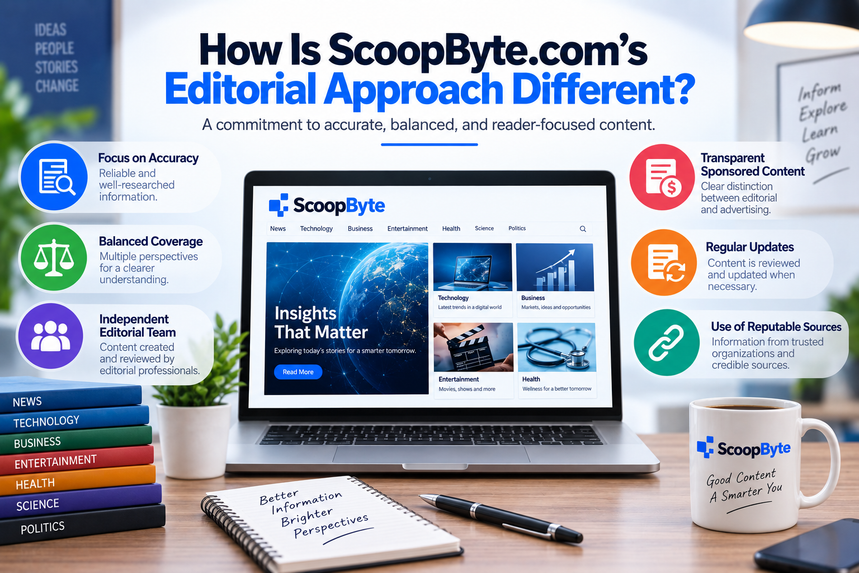
One of the central principles described in ScoopByte.com’s editorial policy is its commitment to accurate, impartial, and well-balanced information.
The policy states that the website covers business, technology, science, politics, and health news and analysis. It also explains that editorial professionals are responsible for content selection, development, and maintenance.
This approach is relevant because readers often encounter conflicting claims online. A publication’s stated emphasis on accuracy and balance provides a framework for understanding its intended editorial standards.
However, readers should evaluate individual articles rather than assuming that every published claim has been independently verified.
2. Separation Between Editorial and Sponsored Content
Another aspect of ScoopByte.com’s stated approach is its distinction between independent editorial content and advertising or sponsored material.
According to its editorial policy, ScoopByte aims to maintain separation between editorial content and materials influenced by sponsors. It also acknowledges revenue from advertising, sponsorships, and related commercial arrangements.
This distinction matters because commercial content can have a different purpose from independent reporting.
Why Does This Separation Matter?
Readers may benefit from knowing whether an article is:
- Independently produced editorial content
- Sponsored material
- Advertising
- Content supplied by a business partner
Clear distinctions can help users understand the context in which information is presented.
ScoopByte’s policy describes its intention to identify sponsored content separately, but readers should still check the labels and disclosures on individual pages.
3. Use of Different Information Sources
ScoopByte’s editorial policy describes a sourcing process that includes staff writers, freelance journalists, and third-party content providers.
It states that third-party sources may include government agencies, universities, nonprofit organizations, and other relevant stakeholders. The policy also says that its editorial staff reviews most external content for accuracy, balance, completeness, and timeliness.
This suggests an approach that combines original writing with information obtained from external sources.
What Should Readers Look For?
When assessing an article, readers can examine:
| Evaluation Factor | What to Check |
|---|---|
| Source quality | Whether information comes from credible sources |
| Accuracy | Whether claims are supported by evidence |
| Completeness | Whether important context is included |
| Timeliness | Whether the information is current |
| Authorship | Whether the author or source is identified |
These are useful evaluation criteria for any informational website, not just ScoopByte.com.
4. Attention to Content Updates
Information can become outdated, particularly in technology, health, finance, and current affairs.
ScoopByte’s editorial policy states that the website reviews its content regularly and may correct, update, archive, or remove content when necessary. It also mentions the use of editor’s notes when changes have occurred.
This is an important editorial consideration because content maintenance can affect how useful an article remains over time.
For example, a guide about an online platform may need updates if the platform changes its services, pricing, or availability.
How Can Readers Check Content Freshness?
Before relying on an article, look for:
- Original publication date.
- Last updated date, if available.
- References to current information.
- Relevant corrections or editor’s notes.
- Links to original sources.
Not every article requires frequent updates, but time-sensitive information deserves additional attention.
5. Editorial Content Versus Partner Contributions
ScoopByte’s editorial policy acknowledges that some areas of its website may contain material from corporate partners and conference organizers.
The policy states that these areas are designed to make it clear when content has not gone through the website’s editorial process.
This is a relevant distinction when exploring a website with multiple content formats.
Readers can ask whether a particular article is:
- Written by the website’s editorial team
- Submitted by an outside contributor
- Provided by a partner
- Sponsored or promotional
Understanding the content’s origin can help readers assess its purpose and context.
6. A Broad Publishing Model
ScoopByte’s editorial policy covers multiple subject areas rather than describing a single specialized niche.
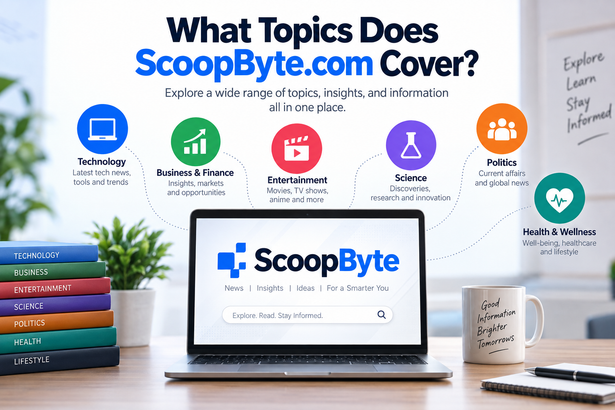
Its stated coverage includes business, technology, science, politics, and health. The website’s broader content offering has also included entertainment and practical online guides.
A broad publishing model can allow a website to serve readers with different interests.
However, topic diversity and editorial quality are separate considerations. A publication can cover many subjects while requiring readers to evaluate the accuracy and depth of individual articles.
Broad Coverage Compared With Specialized Websites
| Feature | Broad Information Website | Specialized Website |
|---|---|---|
| Topic range | Multiple subjects | Focused niche |
| Audience | Readers with varied interests | Specific interest groups |
| Content depth | Varies by subject | May focus deeply on one area |
| Source evaluation | Important across categories | Important within the niche |
| Reader experience | Diverse content discovery | More focused exploration |
This comparison describes general publishing models, not a quality ranking of websites.
Is ScoopByte.com’s Editorial Approach More Reliable?
Reliability should be assessed using evidence rather than the presence of an editorial policy alone.
ScoopByte’s policy describes commitments to accuracy, balance, editorial review, and separation of sponsored content.
At the same time, its Terms of Use contain a disclaimer stating that the sites publish rumors and conjecture alongside accurately reported information, and that content may contain errors or inaccuracies.
These statements are important to consider together.
What Does This Mean for Readers?
The editorial policy explains the website’s stated goals and procedures. The Terms of Use provides additional context about the limitations the website acknowledges.
Readers should therefore:
- Check claims against original sources.
- Consider whether information is confirmed or speculative.
- Review publication dates.
- Be cautious with advice involving money or health.
- Avoid treating general articles as guaranteed professional guidance.
This approach supports informed content evaluation without relying solely on a publisher’s stated standards.
What Makes an Editorial Policy Useful?
An editorial policy can help readers understand how a website says it manages content.
For ScoopByte.com, the policy addresses several areas:
Content selection: The role of editorial professionals in selecting and maintaining content.
Source evaluation: The use of internal and external information sources.
Commercial transparency: The stated separation of advertising and sponsored content from independent editorial material.
Content maintenance: The correction, updating, archiving, or removal of content when necessary.
Reader feedback: The policy provides an email address for questions, comments, and complaints.
These points offer a starting framework for evaluating the website’s publishing practices.
How Should You Evaluate ScoopByte.com Articles?
If you’re exploring ScoopByte.com for information, consider using the following checklist.
1. Identify the Purpose of the Article
Determine whether the article is intended to inform, explain, review, recommend, or promote something.
Different formats require different evaluation methods.
2. Check the Sources
Look for original references, credible organizations, research, or official statements when relevant.
3. Review the Publication Date
Check whether the article’s information is still relevant, particularly for fast-changing subjects.
4. Look for Commercial Disclosures
Determine whether the content is sponsored or connected to a commercial relationship.
5. Compare Important Claims
When an article makes significant claims, consult additional reliable sources before acting on the information.
Frequently Asked Questions
1. What is different about ScoopByte.com’s editorial approach?
ScoopByte’s editorial policy describes a focus on accuracy, balance, editorial review, and separation between independent content and sponsored material.
2. Does ScoopByte.com use external sources?
Yes. Its editorial policy describes the use of third-party sources, including government agencies, universities, nonprofit organizations, and other stakeholders.
3. Does ScoopByte.com update its articles?
The editorial policy states that ScoopByte reviews content regularly and may correct or update material when necessary.
4. Does the website publish sponsored content?
ScoopByte’s editorial policy states that it receives revenue from advertising and sponsorships and aims to distinguish sponsored content from independent editorial content.
5. Should readers verify information published on ScoopByte.com?
Yes. Verifying important claims through credible independent sources is a useful practice, especially for health, financial, scientific, and current-affairs information.
Conclusion
ScoopByte.com’s stated editorial approach focuses on accuracy, balanced information, source evaluation, and the distinction between editorial and sponsored content. Its policy also addresses content maintenance and the use of third-party information sources.
These published standards help readers understand how ScoopByte describes its editorial practices. However, evaluating individual articles remains important because a policy does not independently establish the accuracy of every claim.
By reviewing sources, checking dates, identifying content types, and comparing important information, readers can make more informed decisions about how they use ScoopByte.com.